Taking seriously the creative discomfort of starting where we are: A reflection from Anzaldúa’s Borderlands Workshop at Uni Glasgow
- 06 Apr, 2026
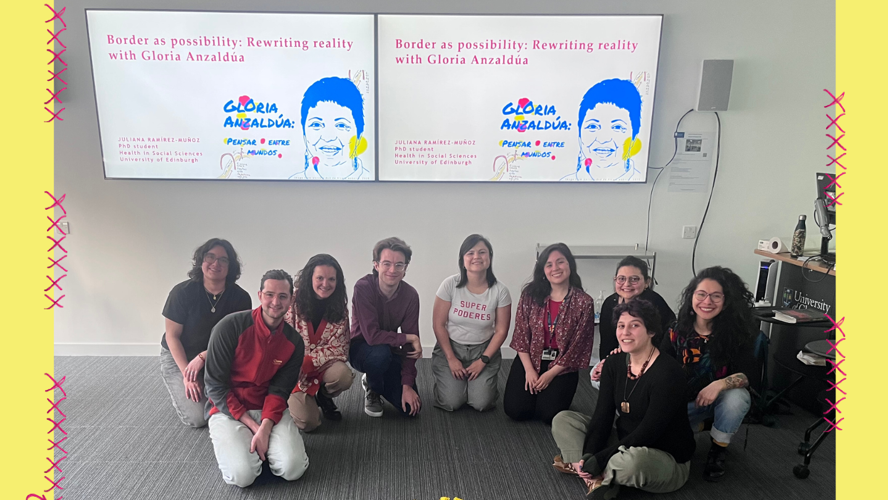
Five days before the workshop “Border as possibility: Rewriting reality with Gloria Anzaldúa,” which the Glasgow Latin American Research Network (GLARN) at the University of Glasgow had invited me to facilitate, I woke up in the middle of the night after a nightmare. In it, I had mistaken the day of the workshop for Friday, when it had actually been scheduled for the previous Monday. It was Monday, people were waiting for me in the room, and I wasn’t ready. I was panicking.
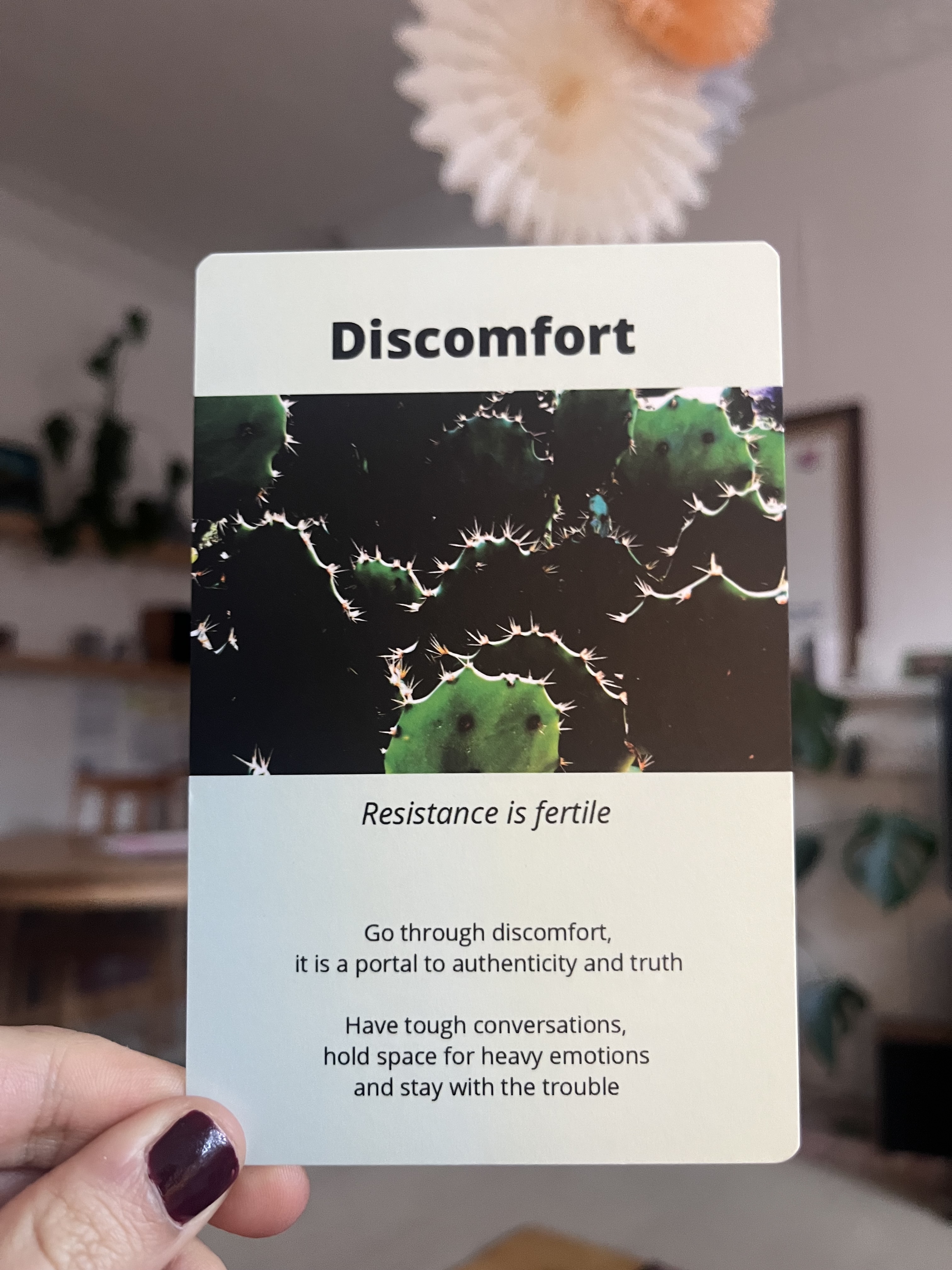
After waking up and failing to fall asleep again, I got up and drew a card from one of my decks. The card was “Discomfort.” It felt almost too accurate—a clear invitation to name what I was feeling: the discomfort of stepping out of my comfort zone to offer this workshop.
I was introduced to Gloria Anzaldúa’s work by Dr. Karen Serra Undurraga—my teacher at the time, my supervisor now—during one of my PhD courses in Health in Social Sciences at the University of Edinburgh in 2023. Since then, Anzaldúa’s autohistoria-teoría has not only become the methodology for my dissertation, but I have also designed and led several workshops based on her work.[1] These had always taken place within my school, among people already familiar with her work, most of them with a background in counselling studies. Importantly, many were also familiar with post-qualitative research through academic spaces like the Center for Creative Relational Inquiry (CCRI).
Accepting GLARN’s invitation meant stepping into a different space. I expected participants from varied backgrounds—some even outside academia—and imagined that those within academia might be working with more “traditional” approaches. My invitation was to spend an afternoon together (which, as it turned out, was a very sunny one in Glasgow) exploring the concept of Borderlands as proposed by Anzaldúa, and thinking about our own work through that lens.
Anzaldúa was a Chicana writer, poet, activist, artist, lesbian, and academic whose life was an ongoing effort to bring together the pieces of her inner sense of fragmentation. Born in a geographical borderland—the border between the US and Mexico—her work explored and challenged borders of all kinds. Writing about the concept of Borderlands, she said:
“the psychological borderlands, the sexual borderlands, and the spiritual borderlands are not particular to the Southwest. In fact, the Borderlands are physically present wherever two or more cultures edge each other, where people of different races occupy the same territory, where under, lower, middle and upper classes touch, where the space between two individuals shrinks with intimacy” (Anzaldúa 1987).
Her writing embodies this questioning: across languages, genres, artwork, critical theory, and mystical knowledge, exploring culture, identity, race, and social justice.[2]
Inspired by Anzaldúa’s sharp challenges to the “unnatural” boundaries she identified in the structures around her—academia, feminist activist spaces, Chicano spaces, spiritual spaces—I conceived this workshop as a space to question our own: Which boundaries do we encounter in our research? How do they shape our work? What kind of world do they produce? How might making them more porous support the social transformations we believe in?
Let me give some examples, in case this feels too abstract. As researchers, when are we hiding parts of ourselves that feel essential to our work? Why do we do it—and are there alternatives that would allow us to feel more coherent? What kinds of changes might emerge, even small ones, if we did something differently? Perhaps it has to do with our writing style. Or with publicly acknowledging that something we are doing comes from intuition, or from an insight we gained through meditation. Perhaps it has to do with moments in which we could be humble and honest enough to admit—despite being positioned as “experts”—that we don’t know, or that what we know comes from a nonlinear, messy, even mysterious process.
What kinds of stories about knowledge and expertise are produced through each of these small decisions—of making something visible or not?
These questions are not new to academia. During my PhD, for example, I encountered the concept of reflexivity, long present in anthropology and closely related to the concerns I raise here. Yet this invitation to question ourselves—especially within spaces of power such as academia—has a long genealogy within feminisms.
I have engaged in this kind of reflection throughout my life, but I was not taught to do so in my formal studies. Consider my background: 18 years ago, I began studying economics, later completing a Master’s in Economics and a Master’s in Public Policy. In none of these spaces was I encouraged to appear in my own work or to critically reflect on my positionality.
However, when I think about my work in peacebuilding and social dialogue in Colombia in recent years, my personal story becomes inseparable from my practice. In particular, my shift from a worldview grounded in modernity’s separations (human/nature, mind/body, science/spirituality) to one rooted in the interbeing (a concept that speaks to Buddhist radical interconnectedness), shapes how I position myself today—as both a dialogue practitioner and a researcher.
Thankfully, my PhD opened a door into decolonial and feminist scholarship—ideas such as situated knowledge, standpoint theory, strong objectivity, and double consciousness. Anzaldúa’s concept of “mestiza consciousness” is one among these—a consciousness that emerges from “creating a new mythos, a change in the way we perceive reality, the way we see ourselves, and the ways we behave” (Anzalduá 1987). I find her inspiring because she didn’t only write about transformation, she showed how to behave differently and so created transformation (my research is proof of this). I wonder how much discomfort she went through considering she was writing almost fifty years ago—daring to theorize the world through her personal stories, poems, imagination, dreams, spirituality, and body.
I am used to asking myself questions about borders, and I have grown more comfortable discussing them with people working in spaces similar to mine, such as my School at the University of Edinburgh. But bringing these questions into a group that included PhD students—as well as lecturers!—in Law, Education, History, International Relations, Political Science, and Health, alongside dancers, counsellors, and storytellers, felt daunting. No wonder I was waking up in the middle of the night, gripped by fear.
Even though I feel more than confident in the journey that took me from a Master’s dissertation grounded in econometrics —using Instrumental Variables and Nonparametric methods—, to an autohistoria-teoría, I still experience the tension of speaking about shifting paradigms in a world that insists on fixed structures. It remains uncomfortable.
And yet, having facilitated this workshop—and feeling deeply satisfied with how it unfolded—I now find joy in writing this reflection. Participants shared in ways shaped by their own stories and fields. There was a shared recognition of borders—especially those within academia that determine what is considered “serious” and thus visible, and what is dismissed and rendered invisible.
The workshop, like this text, was too short to fully explore the richness that emerged across such diverse backgrounds. People situated their reflections within education, health, inequality, identity, and conflict. Across all these fields, adopting a critical decolonial lens inevitably surfaces tensions with dominant academic standards. If we take pluriversality seriously, how do our research practices align with onto-epistemological difference? Are we truly creating space for it within academia? Are we creating a pluriversal academia, or simply writing about it?
This is just one example, but similar questions arise when we think about legal frameworks, school curricula, community engagement, storytelling, or even our writing styles.
I initially thought the title of the workshop—“Rewriting reality with Gloria Anzaldúa”—sounded too ambitious. But hearing participants say they felt “provoked,” that they were thinking about “alternatives,” that they felt “inspired” to do something differently, made me reconsider. Perhaps the name is fitting after all.
The discomfort of questioning what is, and of pushing it toward what could be, is deeply creative… just as my card suggested in the early hours of that Monday morning.
I’m reminded of Buddhist nun Pema Chödrön’s words: “start where you are.” I’m grateful to GLARN for offering a space where I could share that discomfort creatively, alongside others willing to do the same. We are living in times that ask exactly this of us.
Notes
This text was originally published in GLARN Blog. Huge thanks to friend and colleague Irene Piedrahita for inviting me to write and facilitate this wonderful space.
[1] The linked article is not open access. In case you need, please contact me so that I can share it.
[2] For anyone interested in reading more about Anzaldúa’s theories, I suggest reading: “The Anzaldúan Theory Handbook” by AnaLouise Keating.
Bibliography
Borderlands/La Frontera: The New Mestiza. By Gloria Anzaldúa. San Francisco: Aunt Lute Books, 1987.
Dejar un comentario
Cargando comentarios...